Table of Contents
- The Deepfake Threat Landscape Facing UAE Financial Services
- Why the OTP Phase-Out Concentrates Risk at the Biometric Layer
- What Advanced Liveness Detection Actually Means in 2026
- Why Single-Layer Liveness Detection Is No Longer Enough
- What UAE Fintechs Should Prioritise When Evaluating Liveness Detection
- The Regulatory Direction: Why This Will Only Get Stricter
- The Path Forward for UAE Fintechs
The UAE’s fintech sector is entering 2026 at a crossroads. The Central Bank of the UAE has mandated that all financial institutions phase out SMS and email OTPs by March 2026, replacing them with biometric and app-based authentication. We covered the directive itself, the timeline, and the operational impact in our earlier piece on the UAE’s move beyond OTPs. This article picks up where that one ended and asks the next question: what happens when the biometric systems replacing OTPs become the new primary target for fraud?
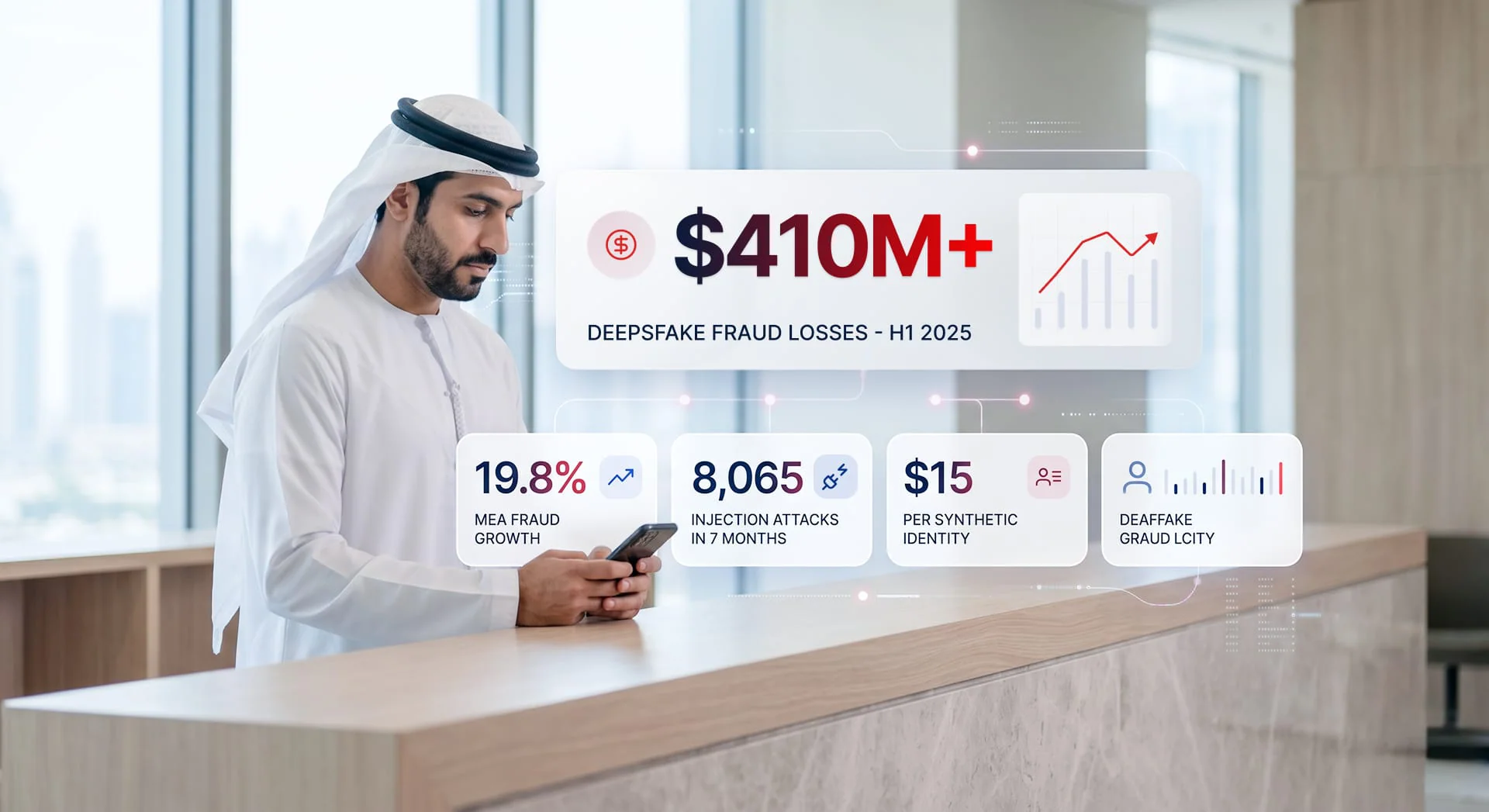
The threat is already visible. Deepfake-related fraud losses exceeded $410 million in the first half of 2025 alone, and the Middle East recorded the highest regional growth in identity fraud at 19.8% year on year. For UAE fintechs, the question is no longer whether to adopt biometric verification. It is whether their liveness detection for deepfakes can withstand the sophistication of today’s attacks. This article explores why advanced, multi-layered liveness detection has become a non-negotiable capability for any fintech operating in the UAE.
The Deepfake Threat Landscape Facing UAE Financial Services
The numbers tell a sobering story. Globally, fraud operations using deepfake technology rose by approximately 1,300% during 2024, and that trajectory has only steepened. A single financial institution recorded 8,065 attempts to bypass liveness checks for digital KYC loan applications using AI-generated deepfake images in just seven months between January and August 2025. These were not crude photoshop jobs. They were injection attacks, where synthetic biometric data is fed directly into a verification system, bypassing the camera sensor entirely.
The economics of deepfake fraud have shifted dramatically. Deepfake-as-a-Service platforms now offer synthetic identity creation for as little as $10 to $50 per image, with ready-to-use identities selling for up to $15. For organised crime networks, the return on investment is extraordinary: individual incidents have exceeded $680,000 in losses, while industry projections estimate that generative AI-enabled fraud across financial services could reach $40 billion annually by 2027.
The Middle East is not a bystander in this trend. The region recorded the highest growth in identity fraud globally at 19.8% year on year, outpacing Asia-Pacific (16.4%) and Latin America (13.3%). Three in ten banks and fintechs across the UAE, US, Germany, and Singapore report biometric verification as the stage most frequently targeted by fraudsters. For UAE fintechs processing millions of verifications annually, even a small percentage of successful attacks translates into significant financial and reputational damage. For a deeper look at how identity fraud is evolving across the region, see our analysis for digital identity and deepfake threats.
Why the OTP Phase-Out Concentrates Risk at the Biometric Layer
The CBUAE’s directive replaces SMS and email OTPs with secure multi-factor authentication built on biometrics, soft tokens, Emirates ID, and UAE Pass. By late 2025, several major banks had already completed the transition. The security question that follows it is less discussed.
When every financial institution in a country funnels authentication through biometric channels, those channels become the single most valuable target for fraudsters. Deepfake attacks are not randomly distributed. They cluster around biometric verification points. Attackers know that if they can defeat the liveness check at onboarding or transaction authorisation, they gain access to the full account lifecycle.
The mandate pushes the ecosystem toward biometrics, which is the right direction. But without advanced liveness detection sitting behind those biometric checks, the transition concentrates risk rather than reducing it. The attack surface gets smaller in some ways and much more valuable in others.

What Advanced Liveness Detection Actually Means in 2026
What is advanced liveness detection? Advanced liveness detection is a multi-layered biometric security capability that confirms a real, physically present person is interacting with a verification system, using presentation attack detection (PAD), deepfake analysis, injection attack prevention, and device integrity checks simultaneously. Unlike basic liveness, which relies on a single prompt like blinking or head turning, advanced systems analyse pixel behaviour, motion inconsistencies, data anomalies, and device-level signals to defeat AI-generated attacks.
The biometric industry measures liveness detection rigour through ISO/IEC 30107, the international standard for presentation attack detection. It defines three PAD levels: Level 1 tests against basic spoofs like printed photos; Level 2 tests against more sophisticated attacks including high-quality 3D masks; and Level 3 tests against advanced, lab-grade attacks using custom-fabricated materials that simulate a well-funded adversary.
For UAE fintechs in 2026, Level 2 has become the baseline expectation, with Level 3 increasingly viewed as a competitive differentiator. But PAD levels alone tell only part of the story. Modern deepfake attacks bypass the camera entirely through injection attacks. They manipulate the data stream between the device sensor and the verification software. A liveness system that only analyses what the camera sees will miss these attacks completely.
The Three Layers of Modern Liveness Defence
Biometric liveness analysis. This is the foundation, detecting whether the face presented to the camera is a real, live person. Facial recognition system maps 80+ facial landmarks with 99.5% accuracy, trained on over 10 million MEA regional samples. Its three-level PAD achieves 99.8% detection for printed photo attacks, 99.5% for video and HD replay attacks, and 98.7% for 3D masks and deepfakes. The deepfake detection model has been trained on more than 5 million synthetic samples, giving it a continuously evolving baseline against the latest generation techniques.
Injection attack prevention. This layer addresses the attacks that bypass the camera sensor. It uses cryptographic validation, device fingerprinting, and temporal validation to ensure that biometric data originates from a genuine sensor in real time, not from a pre-recorded or AI-generated feed injected into the data pipeline. This is the layer most basic liveness systems lack, and the one deepfake attackers increasingly exploit.
Device intelligence. The third layer operates beneath the biometric check itself. It detects emulators, rooted or jailbroken devices, hooking attacks, app cloning, and GPS spoofing. Over 20 configurable risk signals flag whether the device environment itself has been compromised.
To understand how device-level fraud prevention works alongside biometric checks, explore Device Intelligence.
Why Single-Layer Liveness Detection Is No Longer Enough
The conventional approach to liveness detection treats it as a single checkpoint. Typically a prompt during onboarding that asks the user to blink, turn their head, or follow a dot with their eyes. In 2023, this was often sufficient. In 2026, it is a liability.
The sophistication gap between attackers and defenders has narrowed dramatically. Deepfake-as-a-Service platforms provide turnkey tools that generate realistic face swaps, animated selfie videos, and even synthetic identity documents in minutes. These tools do not require technical expertise. They are designed for scale. One documented case uncovered 9,600 linked fraudulent accounts originating from a single device, using a combination of synthetic identities and device manipulation to bypass traditional verification.
Single-layer liveness fails against this threat because it addresses only one vector: is the face real? It does not ask whether the data reaching the system has been tampered with, whether the device itself is compromised, or whether the identity presented matches a known fraud pattern across other applications. Advanced liveness detection answers all of these questions simultaneously. For a detailed explanation of how active and passive liveness modes work together, see our blog on liveness detection.

What UAE Fintechs Should Prioritise When Evaluating Liveness Detection
Not every liveness detection solution is built for the threat environment UAE fintechs face in 2026. When evaluating providers, compliance and risk teams should look beyond headline accuracy numbers and examine whether the solution addresses the full attack chain.
Regional training data matters. Liveness models trained primarily on European or North American populations often underperform on Middle Eastern faces, particularly when handling face coverings, varied lighting conditions, and regional demographic diversity.
Injection attack detection is non-negotiable. Any vendor claiming advanced liveness without injection attack prevention is solving yesterday’s problem. The data is clear: injection attacks are now the primary vector for deepfake fraud in financial services, and they operate entirely outside the camera’s field of view.
Device-level signals add a critical dimension. A compromised device can undermine even the strongest biometric check. Solutions that combine liveness detection with device intelligence, detecting emulators, hooking attacks, and device spoofing in the same verification flow, provide a fundamentally more resilient defence.
Speed cannot be sacrificed for security. UAE fintechs compete on user experience. A liveness check that adds friction will reduce conversion rates.
The Regulatory Direction: Why This Will Only Get Stricter
The OTP phase-out is not an isolated move. The UAE’s broader financial regulatory framework is being modernised and consolidated, with a transitional period running through 2026. Emerging technologies and fintech are explicitly within scope, signalling that biometric authentication standards will continue to tighten.
Globally, the trend is unmistakable. ISO/IEC 30107 PAD Level 2 has become the minimum expectation for regulated financial services, with Level 3 gaining traction as the standard for high-value transactions and sensitive account operations. Regulators in the GCC and beyond are watching the UAE’s approach closely. The mandate is likely to influence similar requirements across Saudi Arabia, Oman, and other regional markets.
For UAE fintechs, the implication is straightforward: investing in advanced liveness detection today is not just about meeting current requirements. It is about building infrastructure that can absorb the next wave of regulatory expectations without requiring a rearchitecture of the verification stack.
The Path Forward for UAE Fintechs
The convergence of the CBUAE’s biometric mandate and the deepfake surge creates a defining moment for UAE financial services. Fintechs that treat liveness detection as a checkbox, a single prompt at onboarding, an afterthought in the verification flow, are building on a foundation that attackers have already learned to crack.
The fintechs that will thrive are those that deploy multi-layered liveness detection: biometric analysis that catches deepfakes at the presentation level, injection attack prevention that secures the data pipeline, and device intelligence that validates the environment before a single biometric frame is captured. These layers need to operate simultaneously, in sub-100ms latency, without degrading the customer experience.
The threat is real, measurable, and accelerating. The technology to counter it exists today. The question for UAE fintechs is not whether they can afford to implement advanced liveness detection. It is whether they can afford not to.
Ready to strengthen your deepfake defences?
uqudo’s unified platform combines advanced liveness detection, device intelligence, and KYC verification in a single integration, purpose-built for the Middle East. Book a demo to see how it works.