At uqudo, we built in the Middle East and Africa, for the Middle East and Africa. Over the past decade, we established ourselves as the region’s leading homegrown identity platform, serving enterprises and governments across banking, fintech, telecommunications, and exchanges with modular products that clients assembled into configurable verification journeys.
The model worked. Clients selected the capabilities they needed, whether that was KYC and document verification, biometric liveness detection, NFC chip reading, or AML screening, and integrated each via SDK or API. Products fed into each other within configured journeys. uqudo became the trusted name in digital identity for regulated industries across MEA.
But serving our clients closely also exposed a gap that no single product could fill.
The Gap the Market Revealed
We delivered strong detection and provided investigation tools within each product. What was missing was a unified layer connecting signals and resolution workflows across all products into one operational view.
Clients experienced capable but compartmentalised tooling. Each product generated valuable outputs, but those outputs sat in separate systems. A fraud signal could not inform a compliance decision. An authentication failure could not surface alongside an AML alert. A device flagged as compromised during a payment could not trigger a screening review.
The market required something different: a Solution that could tie identity assurance, fraud intelligence, and compliance operations into a single decisioning fabric, operating continuously across the customer lifecycle rather than just at the point of onboarding. Not more products. A different architecture. One where transaction monitoring, device intelligence, and screening all draw from the same shared risk context.
Three Pillars, One Orchestration Layer
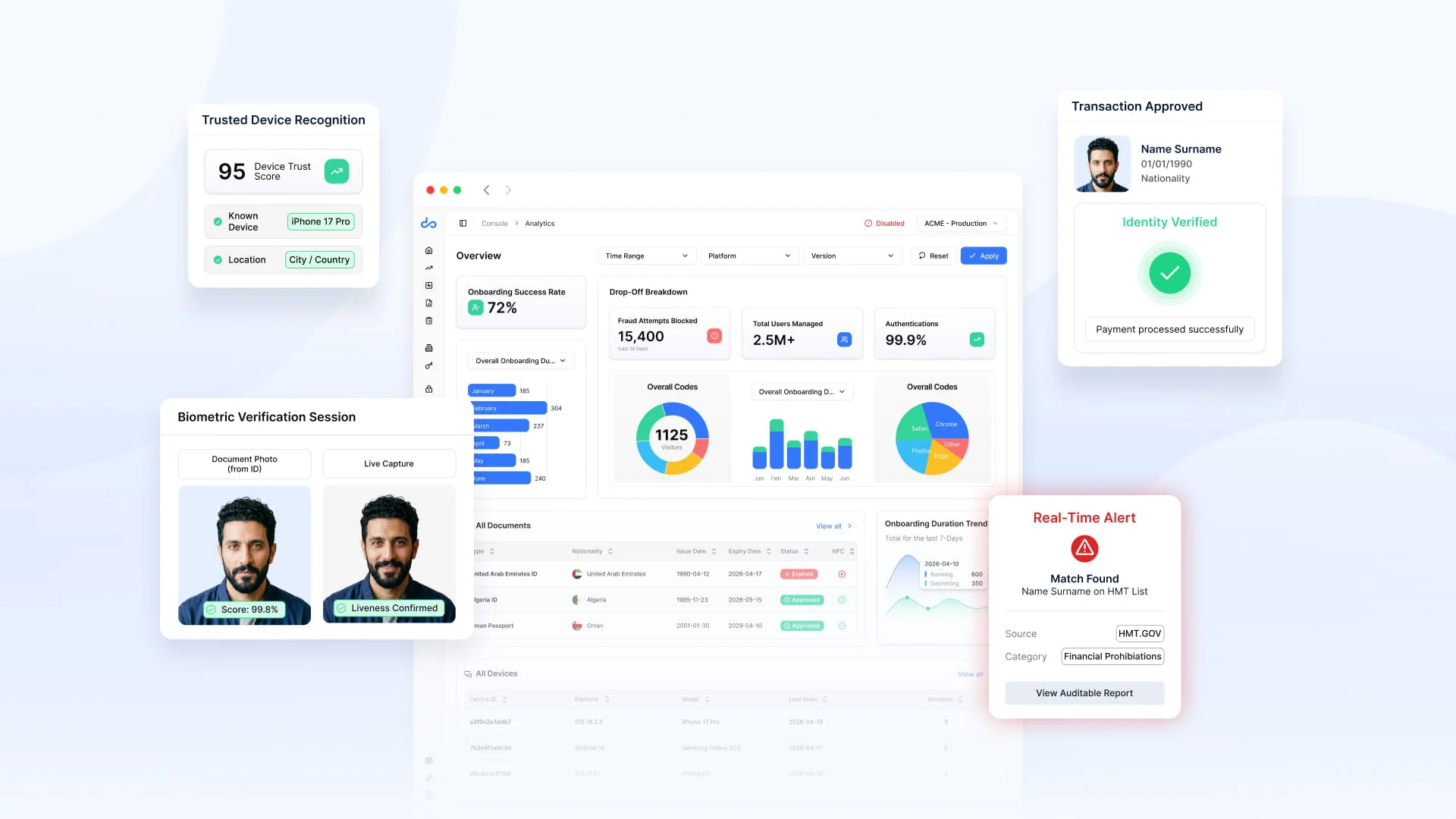
We now operate through three interconnected solution pillars, unified by an orchestration layer that ties all signals and workflows together in real time.
Identity
This pillar establishes who the user is and at what level of assurance. It includes KYC and eKYC with AI document scanning, NFC chip reading, multi-language OCR including Arabic, five-pillar tampering detection, and government database verification. It also includes biometric verification with certified liveness detection across three attack levels, 1:N face search for duplicate detection.
The key shift: these signals are no longer consumed in isolation at onboarding. They persist and are available to the fraud and compliance layers throughout the customer lifecycle.
Fraud
Real-time risk intelligence that layers contextual risk on top of identity signals. Device fingerprinting, behavioural patterns, and duplicate detection combine with the identity assurance level to produce a dynamic risk score. This score informs how the Solution routes each user: low-risk users receive a frictionless path, while higher-risk users automatically trigger deeper checks.
This pillar includes biometric transaction authorisation replacing OTPs and passwords, device intelligence with persistent cross-app identification, behavioural biometrics analysing typing cadence, touch gestures, and session rhythm, and cross-channel transaction monitoring with ML ensemble models.
Compliance
Automated compliance that operates continuously rather than as a one-time onboarding gate. Sanctions screening, PEP checks, and adverse media monitoring draw on identity and fraud signals in real time, enabling automated escalation and case creation when thresholds are breached. Pre-populated regulatory reporting templates support filings across multiple MEA jurisdictions.
What is uqudo’s Orchestration Layer?
uqudo’s orchestration layer is a shared infrastructure component that connects all three pillars into a single decisioning fabric. Identity signals inform fraud risk scoring. Fraud risk changes trigger compliance reviews. Screening results update the risk profile across all layers. Every signal contributes to a shared context, available at every decision point across the customer lifecycle.

What This Changes for Clients and Partners
For Clients, the conversation shifts. It moves from “which products do I need?” to “how do I want my risk operations to work across the entire customer lifecycle?”
That shift has three practical consequences.
The first is risk-based routing. Instead of applying the same verification journey to every customer, the Solution routes users dynamically based on the combined signals from identity, fraud, and compliance layers. Friction is proportional to risk, not uniform.
The second is lifecycle coverage. Identity assurance, fraud monitoring, and compliance screening operate continuously, not just at onboarding. The months and years after a customer is verified are where the real exposure sits, and where compartmentalised tools leave the widest gaps.
The third is detection to action. When all signals converge in a single orchestration layer, the Solution can automatically generate cases, apply investigation workflows, and support regulatory reporting without requiring analysts to reassemble context from multiple systems.
For partners embedding identity capabilities into their own solutions, the same principle applies. A single integration replaces multiple disconnected tools. The orchestration layer means partners can offer their clients a unified risk operations capability without stitching together separate vendor outputs.
Built for MEA, Scaled for the Market Ahead
Our expanded offering is anchored in the same regional depth that made us the leading identity player in MEA. Arabic name matching, non-ICAO standard NFC chips, region-specific document types, in-country deployment meeting data residency requirements, and direct government database integrations remain foundational.
What has changed is the scope. The Solution now extends from the point of onboarding through ongoing fraud detection, transaction monitoring, compliance screening, and case resolution. It is the difference between verifying an identity once and maintaining trust in that identity continuously.
uqudo’s positioning reflects this: a mission-critical vendor rather than a supplementary tool, a compliance-first partner aligned with local market requirements, and a scalable Solution that partners can embed into their own solutions.
Our next chapter is not about adding more products. It is about connecting the ones that matter into a single layer that operates across the full customer lifecycle.